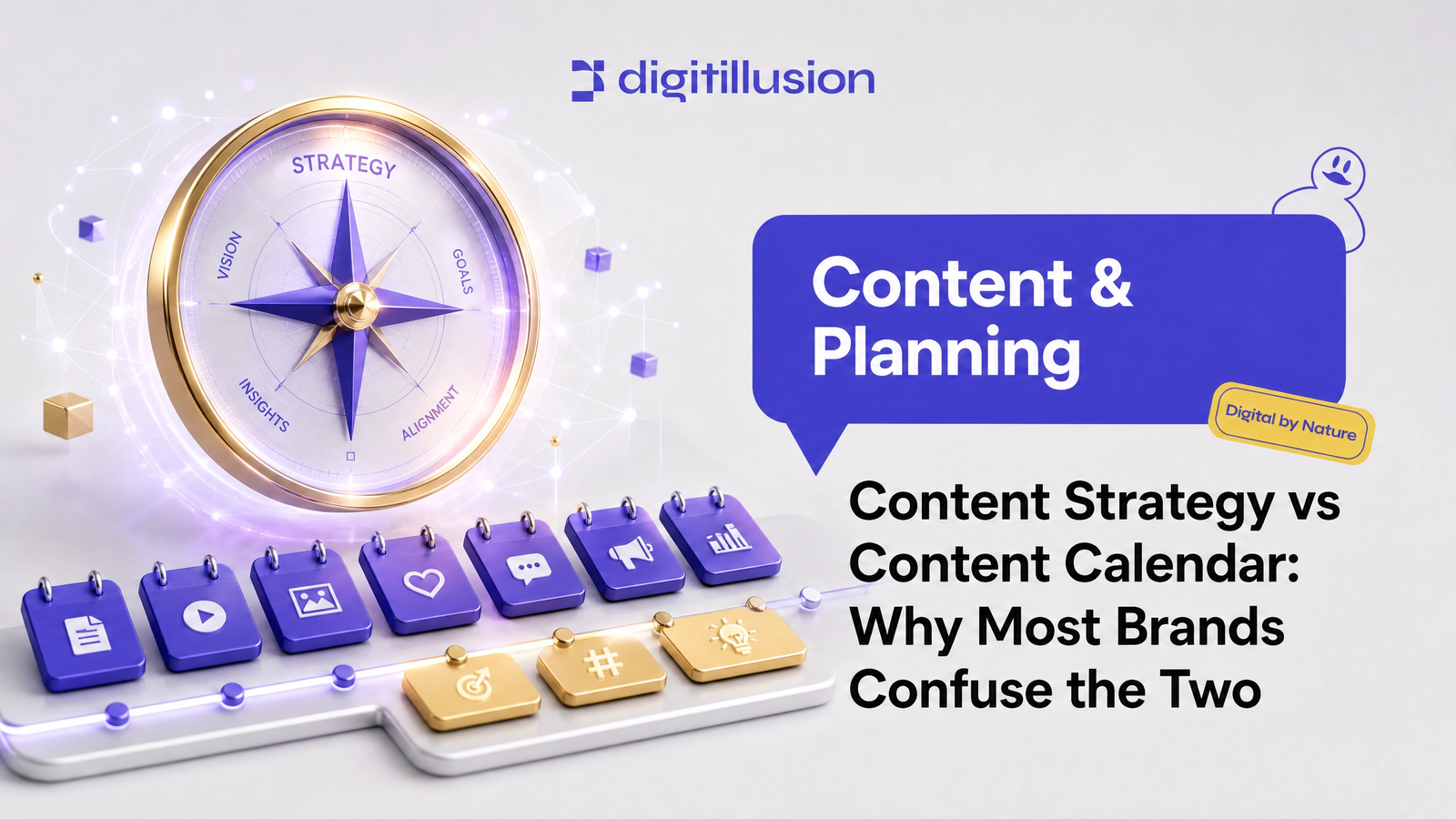
Content Strategy vs Content Calendar is one of the most searched — and most misunderstood — questions in modern marketing. Most brands assume the two are basically the same thing. They’re not. And that confusion is one of the biggest reasons content marketing efforts stall out despite consistent, disciplined posting.
If you can tell us exactly what’s going out next Tuesday but can’t explain why your brand is publishing content in the first place, you don’t have a content strategy — you have a content calendar wearing a strategy’s clothes.
At Digitillusion, a boutique agency working closely with growing brands across industries, we see this pattern constantly. Teams come to us proud of their publishing consistency, only to realize they’ve never actually defined what the content is supposed to accomplish. This article breaks down the real difference at the center of the Content Strategy vs Content Calendar debate, why the confusion happens so often, and how a boutique agency approach fixes it for good.
Content Strategy vs Content Calendar: The Core Difference
The simplest way to understand Content Strategy vs Content Calendar is this: strategy is the why and what; the calendar is the when and how. One is strategic. The other is operational. Confuse the two, and you end up executing beautifully with no direction at all.
What Is a Content Strategy?
A content strategy is the foundation everything else gets built on. It defines:
- Business goals the content needs to support — leads, brand authority, retention, or search visibility
- Target audience — who you’re speaking to, what they search for, and where they sit in the buyer journey
- Core content pillars — the three to five themes your brand consistently owns
- Messaging and positioning — what makes your content different from competitors saying the same things
- Success metrics — how you’ll actually know whether the content worked
A real content strategy is something you could hand to a brand-new hire, and within minutes they’d understand not just what to create, but who it’s for and why it matters to the business.
What Is a Content Calendar?
A content calendar is the execution layer — the schedule that turns strategy into action. It usually includes:
- Publishing dates and posting frequency
- Formats per platform — blog post, Reel, LinkedIn carousel, newsletter
- Assigned owners and deadlines
- Campaign and seasonal tie-ins
A calendar answers “What’s going out on Thursday?” It cannot answer “Should this even exist, and does it move us toward a real goal?” Only strategy can answer that question, which is exactly why the Content Strategy vs Content Calendar distinction matters so much in practice.
Why the Content Strategy vs Content Calendar Confusion Happens
Brands rarely choose to skip strategy on purpose. It happens gradually, usually for three reasons.
First, speed pressure. Teams feel behind schedule, so they open a spreadsheet and start filling in dates instead of stepping back to plan properly.
Second, tool bias. Most popular content and social media tools are built around scheduling, which makes the calendar feel like the strategic center of the entire operation — even though it’s really just execution tooling dressed up as strategy.
Third, activity is easier to measure than impact. “We posted twenty times this month” is a comfortable, easy number to report. “We generated twelve qualified leads from organic content” requires real strategic thinking, proper tracking, and honest attribution — work most internal teams simply don’t have time for.
The outcome is what we call calendar-first content: a fully booked publishing schedule with no underlying logic, where every post competes for attention instead of compounding toward a measurable result. This is precisely the trap that a well-run Content Strategy vs Content Calendar framework is designed to prevent.
Why Getting Content Strategy vs Content Calendar Right Actually Matters
1. Strategy-less content plateaus fast
Without defined pillars and audience clarity, content becomes purely reactive — chasing trends or whatever performed well last week instead of methodically building long-term authority in a specific niche.
2. It wastes time and budget
When there’s no strategic filter guiding decisions, every idea seems equally valid. That means more internal back-and-forth, more content produced for its own sake, and more pieces that go live but never actually perform.
3. It breaks SEO and AI-search compounding
Search engines — and increasingly AI answer engines like ChatGPT, Perplexity, and Google’s AI Overviews — reward topical authority: a clear, interconnected body of content covering specific subjects in depth, often called “content clusters” or “topic pillars.” A calendar with no strategic pillars behind it produces scattered, disconnected content that never builds the depth required to rank well or get cited by AI tools.
4. It makes reporting nearly impossible
If content wasn’t tied to a business goal from the very start, you can’t credibly report on whether it actually worked. “We published forty pieces this quarter” is not a result. “Our pillar content on X drove a thirty percent increase in qualified organic traffic” is a result — and that level of clarity is only possible when strategy comes before the calendar, not after it.
How a Boutique Agency Approach Solves the Content Strategy vs Content Calendar Problem
This is exactly the gap a specialized, hands-on boutique agency is built to close. Unlike large agencies running content on templated playbooks across dozens of unrelated accounts, working with a boutique agency like Digitillusion means:
- Strategy is built with your specific business goals and audience, not adapted from a generic, one-size-fits-all framework
- Your content pillars are researched against real search intent, competitor gaps, and AI-search visibility — not guessed at over a single kickoff call
- The calendar is treated as a living execution layer that gets revisited and adjusted based on real performance data, not a fixed grid filled once a month and forgotten
- You get direct access to strategists who understand your brand, not an account manager simply relaying requests to a disconnected production team
As a boutique agency, Digitillusion starts every single content engagement with strategy first — audience research, pillar mapping, and clear goal alignment — before a single date ever goes on a calendar. In our process, the calendar is always the output of the strategy, never the starting point. That single sequencing decision is often the difference between a brand that publishes consistently and a brand that actually grows because of what it publishes.
How to Resolve Content Strategy vs Content Calendar in Your Own Marketing
- Define one to three measurable business goals your content needs to support this quarter — organic lead volume, brand search demand, or retention content for existing customers.
- Research your audience’s actual search and content behavior — what they’re asking AI tools, what they’re Googling, and where their attention already lives.
- Build three to five content pillars tied directly to those goals. Every future piece of content should trace clearly back to one of these pillars.
- Only then, build the calendar — assign formats, platforms, and publishing dates based on pillar priority and available resourcing, not an arbitrary “post three times a week” habit inherited from nowhere in particular.
- Review monthly against your original goals, not simply against whether the calendar got filled. Adjust pillars and cadence based on real, honest performance data.
Following this sequence is, in essence, the entire Content Strategy vs Content Calendar framework applied in practice — and it’s the exact process our team at Digitillusion runs with every client we bring on.
Content Strategy vs Content Calendar: The Bottom Line
A content calendar tells you when to publish. A content strategy tells you why it matters in the first place. Brands that treat the calendar as the strategy stay busy but directionless — publishing consistently while quietly wondering why growth has stalled anyway.
If your content feels like it’s running on a treadmill instead of building toward something real, the fix usually isn’t posting more often. It’s resolving Content Strategy vs Content Calendar the right way: strategy first, calendar second — which is exactly how a boutique agency like Digitillusion approaches every engagement from day one.
FAQ:
What is the main difference between content strategy and a content calendar? Content strategy defines the goals, audience, and themes behind your content. A content calendar simply schedules when and where that content gets published. Strategy is the why; the calendar is the when.
Is a content calendar part of a content strategy? Yes. A content calendar is a tactical output of a content strategy, not a replacement for it. Strategy comes first and directly shapes what belongs on the calendar.
Why do so many brands confuse content strategy and a content calendar? Because scheduling tools make the calendar feel like the strategic center of content marketing, and posting activity is far easier to track than actual business impact — so teams default to filling dates instead of planning around real goals.
How does a boutique agency handle Content Strategy vs Content Calendar differently than a large agency? A boutique agency like Digitillusion builds strategy around your specific business and audience rather than a templated playbook, keeps you in direct contact with strategists rather than account managers, and treats the calendar as a flexible output that adapts to real performance data.
What’s the clearest sign a brand has a calendar but no real strategy? If you can’t explain how a specific piece of content connects to a business goal — or content topics get chosen based on trends rather than defined pillars — that’s the clearest sign strategy is missing entirely.
CONCLUSION
The Content Strategy vs Content Calendar debate was never really about picking one over the other. It’s about sequencing them correctly — strategy first, calendar second — so every post you publish is working toward something real instead of just filling a date on a grid.
If you’re weighing this decision right now, you don’t have to figure it out alone. At Digitillusion, we work as a boutique agency and true extension of growth-focused brands — building the strategic foundation first, then the calendar that executes it, so your content compounds instead of just accumulating.
Ready to see the process in action? get in touch with our team, No pitch, just a real conversation about your goals.