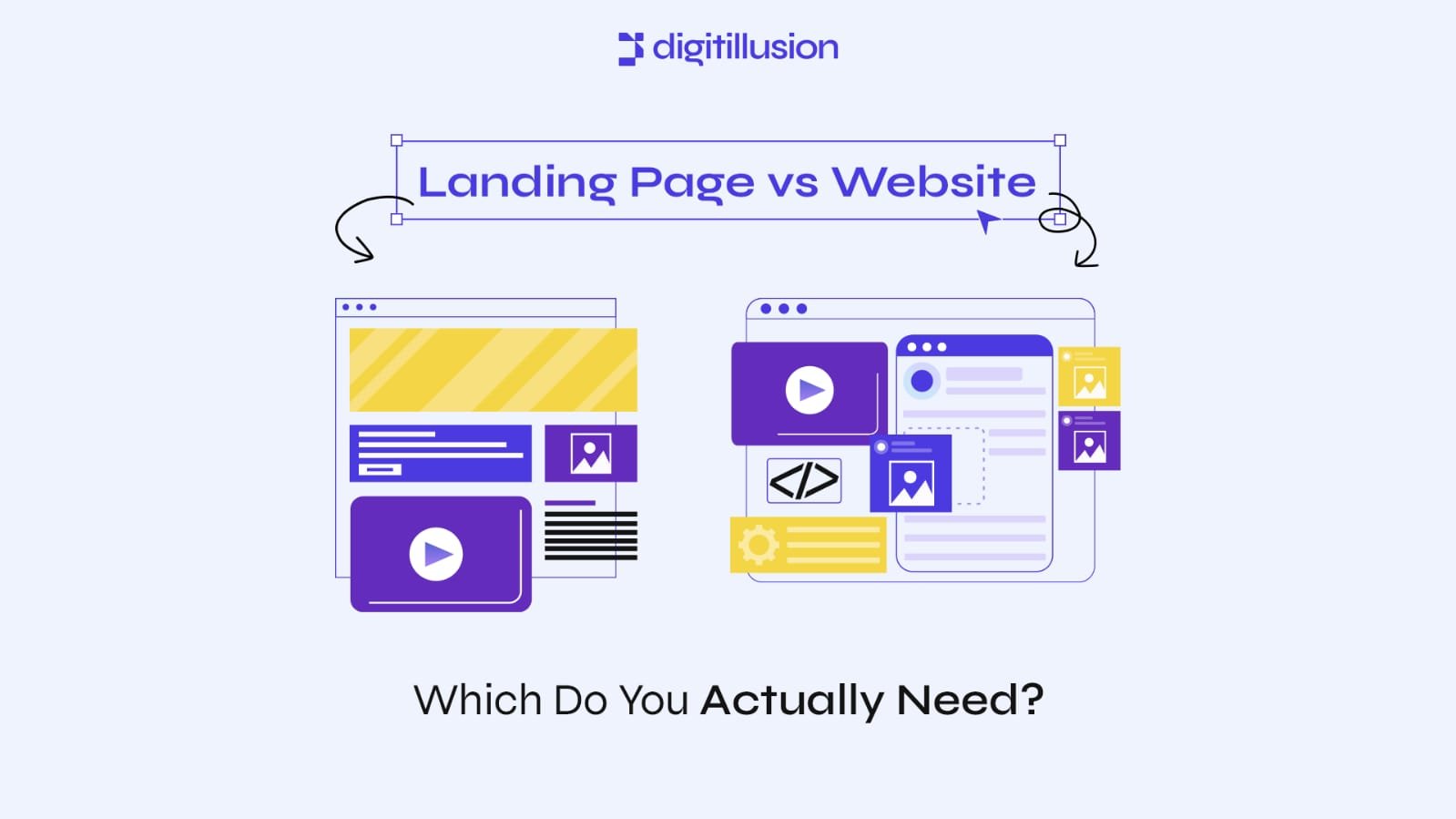
You’ve got a business idea, a product to launch, or a service to promote — and now everyone’s telling you something different. “Just build a landing page.” “No, you need a proper website.” “Actually, do both.” The confusion is real, and the stakes are high.
This is the definitive guide to understanding Landing Page VS Web Site — what each one is, when to use one over the other, and how to make the right call based on your goals, budget, and growth stage.
Before You Continue — The Quick Answer
| You need a Landing Page if… | You need a Website if… |
|---|---|
| You’re running a paid ad campaign | You want long-term SEO traffic |
| You’re launching a single product or offer | You’re building brand authority |
| You’re testing a business idea | You have multiple services to showcase |
| You want fast results at low cost | You’re establishing a corporate or professional presence |
| You’re generating leads from one source | You’re publishing content and blogs |
Short answer: A landing page converts. A website builds. Most growing businesses eventually need both — but the right starting point depends on where you are right now.
What Is a Landing Page?
A landing page is a single, focused web page designed with one goal in mind: getting visitors to take a specific action.
That action might be filling out a contact form, signing up for a free trial, registering for an event, or making a purchase. Everything on the page — the headline, the copy, the visuals, the button — is built to drive that one conversion.
Key characteristics of a landing page:
- Single page, single goal
- No distracting navigation menu
- One clear call-to-action (CTA)
- Optimized for a specific audience or campaign
- Fast to build and easy to test
Landing pages are typically the destination after someone clicks a Facebook ad, a Google ad, or a link in an email. They’re not designed for browsing — they’re designed for converting.
What Is a Website?
A website is a multi-page digital presence that gives visitors a complete picture of your business. It’s your online headquarters.
A typical business website includes a homepage, an about page, a services or products section, a blog, and a contact page. Some include case studies, portfolios, and testimonials. The goal isn’t to push one action — it’s to inform, build trust, and let visitors decide what they want to explore next.
Key characteristics of a website:
- Multiple interconnected pages
- Full navigation with links between sections
- Broad content covering your entire brand
- Built for discovery, trust, and SEO
- Requires more time and budget to build properly
Websites are long-term assets. They compound over time through SEO, content marketing, and word of mouth. They’re not built for one campaign — they’re built for your brand’s lifetime.
Landing Page VS Web Site: Key Differences
Here’s a direct comparison across every dimension that matters to a business owner.
| Factor | Landing Page | Website |
|---|---|---|
| Purpose | Drive one specific action (conversion) | Build brand presence and inform visitors |
| Number of pages | Single page | Multiple pages |
| Navigation | None or minimal | Full menu and internal linking |
| SEO potential | Low (limited content) | High (many pages, blog content, backlinks) |
| Conversion rate | Higher (focused experience) | Lower (more distractions) |
| User journey | Linear — arrive, read, act | Non-linear — browse and explore |
| Speed of launch | Fast (days) | Slower (weeks to months) |
| Cost | Lower upfront cost | Higher upfront cost |
| Analytics tracking | Simple — one goal to track | Complex — multiple goals across pages |
| Best use case | Campaigns, ads, product launches | Brand authority, SEO, ongoing presence |
The bottom line: Landing pages win on speed and conversion. Websites win on trust and long-term visibility.
When Should You Choose a Landing Page?
Choose a landing page when you need results fast, when you’re running a campaign, or when you want to test something before committing to a full build.
1. Paid Advertising Campaigns
If you’re running Meta ads, Google Ads, or TikTok ads and sending visitors to your homepage — you’re wasting money. A homepage is built for exploration, not conversion. A dedicated landing page keeps the visitor focused on the exact offer in your ad, which directly improves your conversion rate and lowers your cost per lead.
Example: A Dubai-based gym runs a Ramadan promotion offering a 30-day free trial. A landing page with a simple sign-up form converts far better than a homepage that also shows gym tours, memberships, and the cafe menu.
2. Product Launches
When you’re launching a new product or service, a landing page lets you create urgency, communicate value, and collect orders or sign-ups — without needing a full website built around that product yet.
3. Event Registrations
Webinars, workshops, pop-up events, and corporate conferences all benefit from a single focused registration page. Visitors arrive, see the event details, and register. No detours.
4. Lead Generation Campaigns
If your goal is to collect names, emails, or phone numbers — especially from paid or organic social media — a conversion-focused landing page with a form is the right tool. It removes friction and keeps the visitor’s attention on the offer.
Example: An e-commerce store in Cairo runs a WhatsApp campaign. They send interested customers to a landing page offering a 15% discount in exchange for their email. The landing page does one thing: collect that email.
5. Testing a New Business Idea
Before investing in a full website or physical operations, a landing page lets you validate demand. You put up the page, run some low-budget ads, and measure how many people actually want what you’re offering. It’s the fastest, cheapest way to test a concept.
When Should You Choose a Website?
Choose a website when you’re building something that lasts — a brand, a reputation, and an organic traffic channel.
1. Building Brand Authority
A website is your digital credibility. When potential clients search for your business, a professional multi-page website signals that you’re established, trustworthy, and serious. A landing page alone can make your business look like a pop-up.
2. Long-Term SEO Strategy
Landing pages have limited SEO potential. Websites, especially those with active blogs, can rank for dozens or hundreds of keywords over time. Every blog post you publish is a new opportunity to be found on Google — and to attract the right audience without paying for ads.
If you want organic traffic six months from now, you need a website today.
3. Publishing Blogs and Content
Content marketing is one of the highest-ROI strategies for growing a business online. You need a website with a blog section to make that happen. Landing pages can’t host an ongoing content strategy.
4. Showcasing Multiple Services
If your business offers more than one product or service, a website gives each offering its own dedicated page — with the right copy, visuals, and SEO optimization. A single landing page can’t contain all of that cleanly.
Example: Digitillusion offers branding, web development, social media management, and performance marketing. Each service deserves its own page with targeted messaging. A single landing page would force everything into one long scroll that confuses visitors.
5. Corporate or Professional Presence
For B2B businesses, agencies, law firms, medical clinics, or any business where credibility is the primary purchase driver — a full website is non-negotiable. Clients will research you before they contact you. If all they find is a landing page, they’ll move on to a competitor with a proper web presence.
Can You Use Both Together?
Yes — and this is actually what most successful businesses do.
The strategy works like this: your website serves as your brand’s permanent home, handling SEO, content, and credibility. Your landing pages serve as campaign-specific conversion machines, each one aligned with a specific ad, audience, or offer.
How the combination works in practice:
- Your website ranks on Google for “branding agency Dubai” and brings in organic leads.
- You run a Meta ad promoting a free brand audit.
- The ad clicks through to a dedicated landing page — not your homepage — that explains the offer and collects sign-ups.
- The lead converts, then later explores your full website to learn more about your services.
This hybrid approach gives you the best of both: sustainable organic growth from the website, and fast, measurable conversions from campaign-specific landing pages.
Many businesses start with just a landing page to validate demand, then build a full website once they have early traction and a clearer picture of their audience.
Common Mistakes Businesses Make
1. Sending Paid Traffic to a Homepage
This is one of the most expensive mistakes in digital marketing. When someone clicks your ad expecting a specific offer and lands on a generic homepage, they bounce. You paid for that click. You got nothing in return. Always match the ad to a dedicated landing page.
2. Building a Large Website Before Validating Demand
Some founders spend months and thousands of dirhams or pounds building a full website — before they’ve confirmed that anyone actually wants what they’re selling. Build a landing page first. Validate. Then invest in the full site.
3. Ignoring SEO Opportunities
Many businesses build a website but never invest in SEO or content. A website with no blog, no keyword optimization, and no backlinks is essentially invisible on Google. If your website isn’t attracting organic traffic, it’s underperforming as an asset.
4. Not Measuring Conversions
Whether you have a landing page or a website, you need to track what people do on it. Most businesses skip this entirely. They don’t know their conversion rate, which pages drive the most leads, or where visitors drop off. Without that data, you can’t improve.
5. Treating a One-Page Website Like a Landing Page
A one-page website has a navigation menu and covers multiple sections (about, services, contact). A landing page has no navigation and a single CTA. These are different tools. Using a one-page website for an ad campaign means your visitor can navigate away from your offer — which defeats the purpose.
How Digitillusion Helps Businesses Choose the Right Solution
At Digitillusion, we don’t believe in one-size-fits-all answers to the landing page vs website question. The right solution depends on four things: your business goals, your current stage of growth, your marketing channels, and your budget.
Before we recommend anything, our team looks at the full picture:
- Are you running paid ads right now, or planning to?
- Do you have organic search traffic, or are you starting from zero?
- Is your goal to generate leads, build awareness, or sell directly?
- How quickly do you need results?
Based on that, we recommend one of three paths:
Landing page only — for businesses running targeted campaigns, testing a new offer, or working with a limited launch budget.
Full website — for businesses ready to invest in their long-term brand presence, SEO, and content marketing.
Hybrid strategy — a full website plus dedicated campaign landing pages — for businesses scaling their digital marketing across multiple channels.
Our services cover every part of that journey:
- Branding — defining your visual identity and positioning before any page is built
- Web Development — building fast, conversion-optimized websites and landing pages that reflect your brand
- SEO Services — making sure your website gets found on Google through content and technical optimization
- Performance Marketing — running Meta, Google, and TikTok ads that send the right traffic to the right page
- Social Media Management — building your organic presence alongside your paid strategy
- Influencer Marketing — amplifying campaigns with the right voices in Egypt and the Gulf
We operate across Dubai and Cairo, serving ambitious SMBs who are ready to grow — not just online, but in their markets.
FAQ: Landing Page VS Web Site
Is a landing page better than a website?
Neither is universally better — they serve different purposes. A landing page is better for converting visitors during a specific campaign. A website is better for building brand authority and generating long-term organic traffic. If you’re running ads, use a landing page. If you’re building for SEO and credibility, use a website.
Can a landing page rank on Google?
A landing page can rank on Google, but its SEO potential is limited. It has only one page of content, no internal linking structure, and no blog — all of which are key for strong organic rankings. Landing pages tend to rank best for very specific long-tail keywords or branded searches. For broader SEO success, a full website with regular content is far more effective.
Do startups need a website or a landing page?
Most early-stage startups benefit more from a landing page initially. It lets you validate your idea, start collecting leads, and launch quickly without a large investment. Once you’ve validated demand and have early customers, building a full website becomes the logical next step.
Is a one-page website the same as a landing page?
No. A one-page website is a condensed version of a full website — it includes navigation links, multiple sections (about, services, contact), and is meant for general browsing. A landing page has no navigation, focuses on a single goal, and is designed specifically for a campaign or conversion. Using a one-page website as a landing page weakens its conversion power because visitors can navigate away from your CTA.
Can I run ads without a website?
Yes, you can run ads and send traffic to a standalone landing page without a full website. Many businesses do exactly this when launching a campaign or testing a new offer. However, for long-term brand credibility and retargeting effectiveness, having a full website alongside your campaigns is strongly recommended.
Can I convert a landing page into a website later?
Yes, and this is a common growth path. Many businesses start with a focused landing page, validate their offer, and then expand it into a full website as the business grows. The landing page content — especially testimonials, offer copy, and conversion-tested messaging — often becomes the foundation of the full website’s homepage and service pages.
What makes a landing page effective?
An effective landing page has five core elements: a clear headline that matches the ad that brought the visitor there, a compelling value proposition, social proof (testimonials, reviews, or client logos), a single and obvious call-to-action, and fast load speed on mobile. Removing distractions — especially navigation menus — consistently improves conversion rates.
The Final Word on Landing Page VS Web Site
The question isn’t which one is better in general — it’s which one is right for your business right now.
If you’re launching a campaign, testing an offer, or driving paid traffic, a Landing Page VS Web Site comparison will almost always point you toward the landing page as the immediate priority. If you’re building for the long term — brand equity, SEO, and organic growth — you need a full website.
And if you’re serious about scaling, the answer is both: a website that builds your presence over time, and landing pages that convert every campaign you run.
Not sure which one your business needs right now? Digitillusion works with SMBs across Dubai and Cairo to evaluate your goals and build the right digital foundation — landing page, website, or both. Talk to our team and we’ll tell you exactly where to start.